Fragrance Export Mistakes: Shipping and Customs Traps for Haircare
Most fragrance shipments that stall at a border do not stall because of the product. They stall because paperwork was written once, copied forward and never re-checked against the destination market. Classification, ingredient naming, alcohol content and the words on the label are the four points where a hair-care scent shipment most often goes wrong, and all four can be settled before the booking is made rather than after the container is on the water.
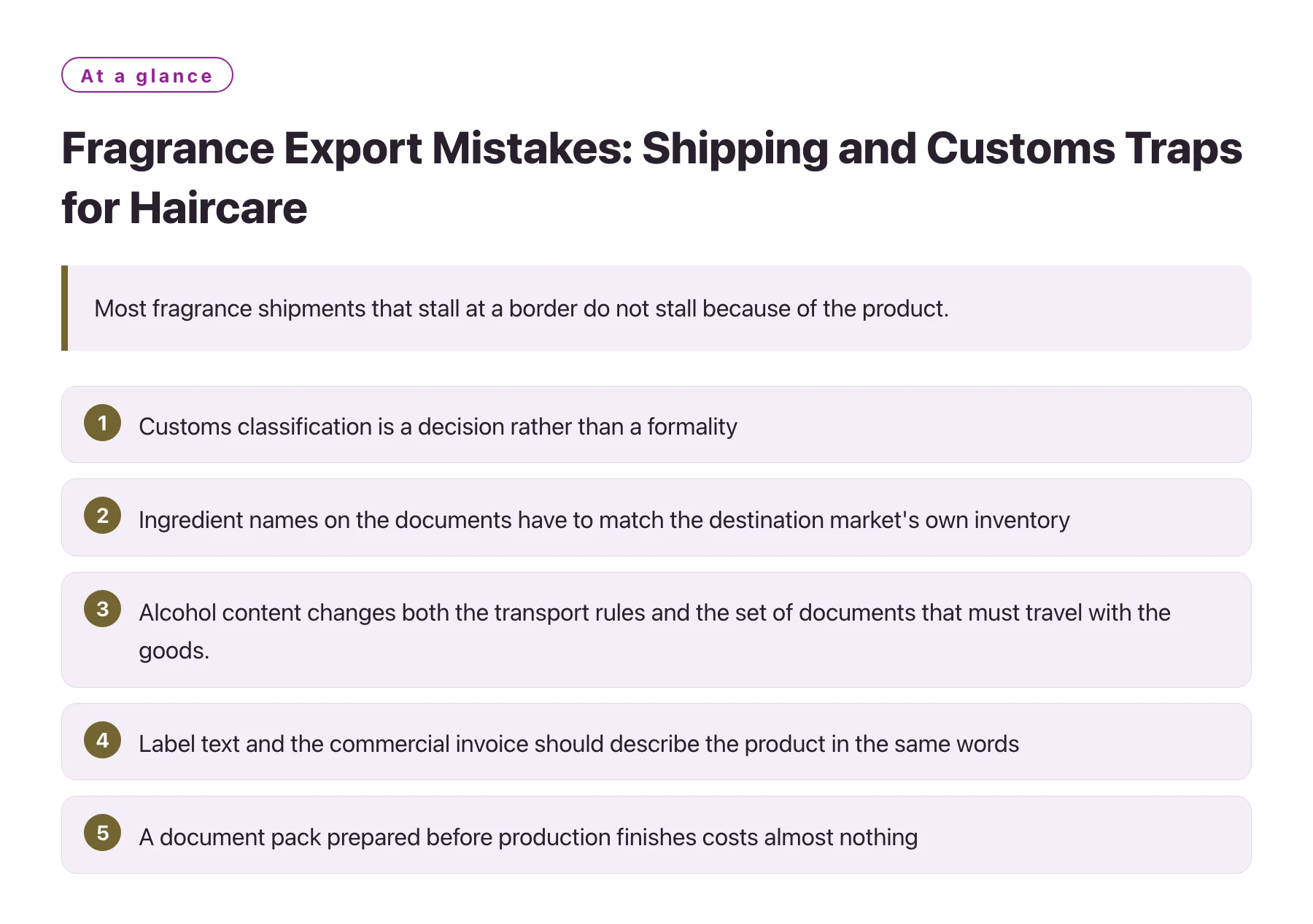
Key takeaways
- Customs classification is a decision rather than a formality, and the same hair mist can sit under different codes depending on how it is presented and what it is sold for.
- Ingredient names on the documents have to match the destination market's own inventory, not the supplier's internal naming.
- Alcohol content changes both the transport rules and the set of documents that must travel with the goods.
- Label text and the commercial invoice should describe the product in the same words, or an inspection will stop the shipment on a technicality.
- A document pack prepared before production finishes costs almost nothing; the same pack assembled after the vessel sails costs storage, rebooking and sometimes a rejected consignment.
A haircare brand moving into scent runs into an unfamiliar problem. Its existing logistics were built around products that customs officers recognise instantly - shampoo, conditioner, serum - and a scented hair mist or a fragrance oil for hair does not sit neatly in that mental catalogue. That is where delays begin, usually well before anyone opens the carton.
This is written for the operations or procurement person who owns the first import and does not want to discover the rules at the port. It covers the mistakes that repeat across markets, then the documents that follow the goods, and finally the point most buyers get wrong: deciding where the manufacturer's responsibility ends.
Start with what the product is, not what marketing calls it
A product name is a brand asset. A customs description is a legal statement, and the two do not have to match. Hair mists sold as fragrance, as a styling product or as a treatment can be classified differently depending on composition, packaging and how the product is presented to the consumer. Founders often assume the code is fixed by the category they sell in, then discover the broker has proposed something else entirely.
The fix is early and cheap: send the formula, the packaging specification and a photograph of the final artwork to the broker before the first order is placed. Classification questions are easy to answer when the product is still being developed and expensive to answer when it is already packed and palletised.
Classification follows presentation
A pump spray, an aerosol and a rollerball can take different routes, because transport rules ask how the contents are dispensed as well as what they contain. Getting the pack format locked early avoids a late re-classification that invalidates documents already issued.
Six mistakes and how to close them
| Mistake | How it shows up at the border | How to close it |
|---|---|---|
| Reusing one document set for several markets | A dossier that satisfies one authority but is missing a notification or a language requirement in another | Build a market-specific pack and record which version shipped with which order |
| Ingredient names taken from internal naming | The inspector cannot match the ingredient to the local inventory | Ask the manufacturer for names as they appear in the destination market's ingredient database |
| Alcohol content assumed rather than stated | The carrier treats a flammable liquid as a general cargo item, or refuses it at the gate | Declare the true flashpoint and alcohol level on the transport document from the start |
| Invoice and label describing the product differently | A hold for a mismatch that looks like a classification error | Use one approved product description across invoice, packing list, label and manifest |
| Declaration signed by someone without authority | A document rejected on procedural grounds after the goods arrive | Agree in advance who signs the commercial documents and keep the mandate current |
| Samples shipped on commercial paperwork | Duty assessed on a consignment that was meant to be a sample | Separate sample logistics from production logistics and label samples accordingly |
None of these is exotic. They appear in the same order, in the same handful of markets, which is why a template that carries the check rather than the answer is worth building once.
Documents that travel with the goods
A cosmetic shipment moves on a stack of paperwork that has to agree with itself: commercial invoice, packing list, transport document, certificate of origin where applicable, plus the safety and quality documents specific to cosmetics. Destination markets maintain their own cosmetic frameworks, so the requirements follow the market the goods enter rather than the manufacturer's home country [1].
Canada is a useful example of how much a pack can differ. It requires cosmetic notification and has its own labelling expectations, so a dossier assembled for one market rarely transfers without changes [2]. Buyers who plan for that from the start treat the document pack as a product specification rather than an afterthought.
The most expensive failure is a document set that is complete but internally inconsistent - a net weight on the packing list that does not match the label, a product name spelled two ways, a batch number that exists in one place only. Consistency is what an inspector checks first, and it is free to get right.
Samples are paperwork too
Development samples move on different terms from production, and mixing the two creates customs histories that are hard to unpick later. Keep sample shipping on its own paperwork, with its own declared value and purpose, so the production record stays clean.
Transport rules for alcohol-based products
Fragrance and hair mists frequently contain ethanol, which puts them inside the general framework countries apply to flammable and otherwise regulated chemicals in transport [3]. That is not a reason to avoid the product; it is a reason to have the safety data sheet, the flashpoint figure and the packing declaration ready before anyone requests a quote from a carrier.
The practical consequence for a haircare brand is that a carrier may ask questions a cosmetics supply chain has never had to answer. Answering them early keeps the shipment on the same schedule as the rest of the range instead of running on an exception process.
Write the destination market on the first line of every document request. Most late-stage export problems are not legal problems at all - they are the result of a document template that quietly assumed the wrong country.
Where the manufacturer's paperwork ends and yours begins
A good factory will hand over the documents it is responsible for: the technical and safety file, the certificate of analysis, the ingredient declarations it is able to make, and the origin paperwork. It will not, and should not, act as the importer of record or guarantee that the product meets your market's rules. That duty belongs to the brand that puts the product on sale.
Still, supplier side maturity is easy to observe. A manufacturer that exports regularly keeps a standard pack ready and can describe its scope precisely, and a company such as Xuelei publishes that scope on the Xuelei website. Use it as a checklist to compare suppliers, not as a substitute for your own compliance work. A partner that runs the whole process in house, like a contract manufacturer for perfume brands, will normally be able to tell you in one list which documents it issues and which it does not.
Build a one-page shipping file
Keep a single sheet per order: product description, classification code, declared alcohol content, market-specific documents, signatory, carrier requirements and the destination contact. When something goes wrong at the port, that sheet is the only document anyone actually needs.
Sources
- European Commission: Cosmetics in the EU —— The European Commission's overview of EU cosmetics rules, including the responsible person, product information file and safety report requirements.
- Health Canada: Cosmetic Safety —— Health Canada's cosmetics pages, covering cosmetic notification, the ingredient hotlist and safety requirements for cosmetics sold in Canada.
- UNEP: Chemicals and Pollution Action —— The UN Environment Programme's pages on chemicals management, including the sound management of chemicals in products.
Frequently asked questions
Who is responsible for customs compliance on a fragrance shipment?
The importer of record is responsible for classification, duty and market compliance, which in most cases means the brand rather than the manufacturer. The factory supplies technical documents and origin paperwork, but it cannot take on the legal duty that belongs to the importer.
Do fragrance and hair mist shipments need a safety data sheet?
In practice yes, because carriers and customs authorities ask for one, and any alcohol content puts the product inside transport rules for flammable liquids. Ask the manufacturer for a current sheet that matches the formula being shipped, not the formula from two years ago.
Why does the same product get a different classification in two markets?
Because classification depends on composition, packaging and intended use, and each customs administration applies its own schedule. The same hair mist can be treated as a cosmetic in one market and as a fragrance preparation in another, which is why broker input matters early.
How far in advance should export documents be prepared?
Before production finishes, ideally before the artwork is final. The technical file, label copy and ingredient declarations all take longer to correct than to create, and a change after packing usually means reprinting labels for the whole order.
Can we ship development samples without full commercial paperwork?
Samples still need documentation, but a different kind: an accurate declared value, a clear purpose, and a product description that matches the label. Shipping them as ordinary commercial goods creates duty and record-keeping problems later.